EUROPEAN FAMILY THERAPY ASSOCIATION
CONNECTING FAMILY THERAPISTS AND TRAINERS
EFTA Conversation: Improvisational Music as a Living System: Training the Therapist’s Senses in Exploring-Understanding Group/Couple and Family Dynamics, through an analogy in music
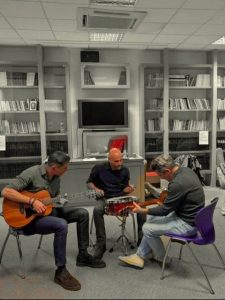
With Nikos Kaitsas, Antonis Antoniou and Vassilis Charalambopoulos
Chairperson: Umberta Telfener
“Don’t play what’s there, play what’s not there”
Miles Davis, jazz musician
“The emotional reaction is all that matters. As long as there’s some feeling of communication, it isn’t necessary that it be understood”
John Coltrane, jazz musician
In both group, couple, family therapy and improvisational music, relationships evolve through a non-conscious, but constantly creative manner. These processes follow a number of principles that are common. The notions of time, rhythm, main theme, conversational mode, synthesis, creative pause, being in the present moment, emotional mirroring and connection, nonverbal communication, call-and-response patterns, resonance, co-dependency, co-regulation, autonomous expression, mirror neurons communication and diversion are present in a family/group context as well as in a musical trio which improvises by sharing notes, ideas and sounds.
By incorporating these principles, among others, the family and group therapist helps to create a space that welcomes and acknowledges a family state of being and communicating, while also provides provocation that might help the family/group to consider new possibilities
In this workshop a group of three therapists and musicians, will perform a short piece of improvised music in real time, demonstrating analogical ways that therapists could listen and perceive what happens in various therapeutic settings. Following the performance, participants will engage in reflective discussion regarding their actual experience of hearing the music and watching the creative process, as well as the connection among the aforementioned principles and how they are present in therapeutic practice.
Through this experiential approach, therapists will be invited to consider new ways of listening, understanding, connecting, responding, and co-creating change in their therapeutic/clinical context.
Vassilis Charalambopoulos MSc,CGP, works where conversation meets action.
For more than 30 years, his work has unfolded in therapy rooms, communities, and training spaces—moving between people’s stories and the realities that shape them. From addiction counselling to family and group therapy, his focus has remained the same: how relationships organise experience, and how change becomes possible within them.
In 2000, he co-founded the Centre for Research of Human Behaviour, contributing to the development of one of the first non-governmental initiatives in Greece dedicated to the prevention and treatment of addictions. Since then, his work has extended across Greece, Cyprus, the United Kingdom, and many other European countries engaging with communities, professionals, and systems of care.
His formation combines counselling, psychotherapy, leadership and the management of health organisations. His systemic orientation was shaped through a decade of intensive experiential training at the Athenian Institute of Anthropos (AKMA), where he is now part of the Coordinating Scientific Team, active in therapy, supervision, and the training of future practitioners.
In 2008 he received a recognition award for contribution to mental health service from the Ministry of Health in Cyprus. He is a Board member of the European Family Therapy Association, participating in the ongoing dialogue shaping systemic practice in Europe. He is also a clinical member of the American Group Psychotherapy Association and many addiction counselling associations.
Alongside his professional work, music remains a constant—informing his sensitivity to rhythm, timing, and listening.
At the core of his work: to stay in relation, to work within complexity and to open space where new meanings can emerge.
Antonis Antoniou: How can art and science coexist and converse? How can I be a responsible, reliable and caring therapist and a creative, free- thinking person, connected to the social, political and historical context of my time? How can « either… or… » become « both… and… »?
Antonis Antoniou has been trying to attend to these questions -among others- for the past 25 years. He has worked in a number of organizations supporting people who face social exclusion (imprisoned, immigrants, refugees, « street children »), and at his private practice as a therapist, trainer and supervisor. He has trained at the Athenian Institute of Anthropos, where he is currently a collaborator. At the same time, he has been playing drums and percussion since his early childhood and continues to write and play music to this day. His love for art and music as well as his continuing studies on human systems (couples, families, groups) shape his overall approach to his work and his life. They have also brought him close to these two beloved friends and colleagues, with whom he shares these common passions and concerns, and together they dreamed and put together this workshop. It is an exciting, fun and deeply interesting challenge that leads to different directions, realizations and questions every time it is applied. Just as art (and science) are supposed to.
Nikos Kaitsas is a psychologist and systemic group psychotherapist based in Greece, with over 20 years of clinical and training experience. He is deeply involved and served in scientific associations such as the Hellenic Association of Systemic Therapy (HELLASSYTH), ΕΕΨΕ, as member, secretary general and Vice President.
For many years he worked in social welfare and child protection organizations as a therapist, supervisor and trainer. He is involved with music since he was 5. He is mainly a guitarist but loves to experiment with other instruments, such as piano, percussion and bass guitar.
His work integrates applications of systemic epistemology, thinking, group process, and embodied awareness, drawing from both psychotherapy and his long-standing engagement with music as a practice of « relational attunement » and improvisation. In response to the increasing fragmentation and uncertainty of the contemporary world, he is currently engaged in developing collective-oriented therapeutic and educational spaces that emphasize connection, co-regulation, and shared meaning-making. He collaborates closely with a network of very talented, inspiring and experienced colleagues in group and family therapy, co-creating initiatives that bring systemic practice into dialogue with cultural context and promote social change, with a particular focus on how groups can function as living systems of resilience and transformation.
SIGN UP